When most people think about collision repair, they picture technicians replacing damaged panels, matching paint, and restoring a vehicle’s appearance.
What they may not see is the work required for the cameras and sensors behind today’s driver assistance features.
That’s where Advanced Driver Assistance Systems (ADAS) calibration comes in.
At CARSTAR Robert’s Collision in Monterey, we partner with Monterey Coastal Scanning, a separate ADAS calibration business that rents space on our one-acre lot.
Our team handles the collision repairs, while Monterey Coastal Scanning provides applicable ADAS calibration using specialized technology and manufacturer-guided procedures. Having our calibration partner on site helps us coordinate the work, expedite the repair process, and repair vehicles more efficiently.
So what actually happens during calibration? Here’s a general look at the process. The specific steps and their sequence depend on the vehicle and the manufacturer’s requirements.
Step One: Identify the Vehicle’s Calibration Requirements
Before calibration begins, the vehicle’s equipment and repair history must be reviewed.
Which cameras and sensors are installed? What was damaged? Which components were removed, replaced, or repositioned during repairs?
Vehicle-specific manufacturer information determines whether those repairs require calibration and which procedures apply.
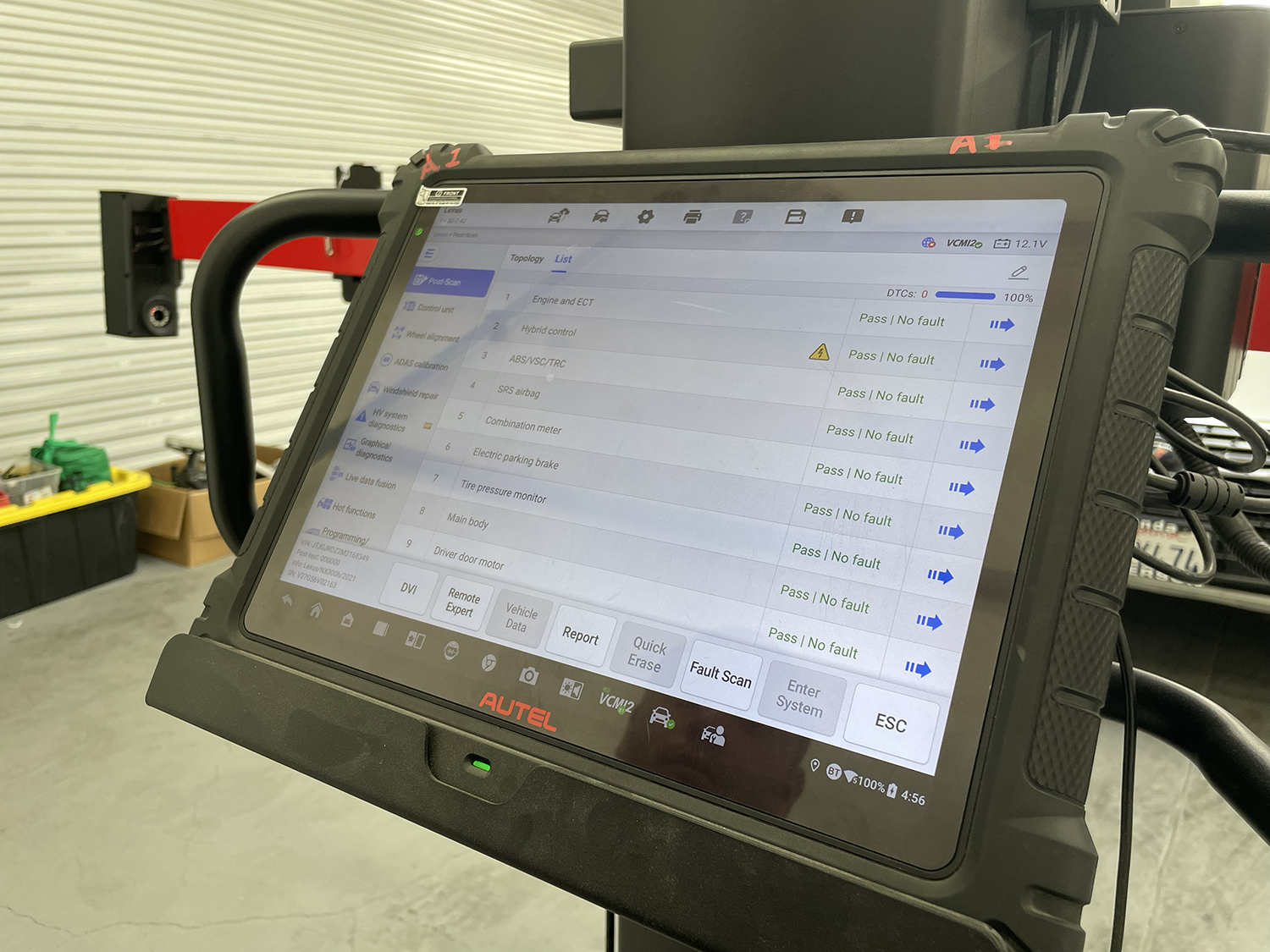
Diagnostic scanning may also provide information about the vehicle’s electronic systems and any stored trouble codes. However, a scan alone does not determine every calibration requirement. Manufacturer repair procedures remain essential.
This preparation helps establish what the vehicle needs before the calibration work starts.
Step Two: Check That the Vehicle Is Ready
Successful calibration depends on meeting the required preparation conditions.
Depending on the vehicle and system, these checks may include:
- Confirming relevant repairs are complete
- Inspecting cameras, sensors, and mounting brackets
- Checking tire pressure and vehicle loading
- Confirming alignment or ride-height requirements
- Checking for faults that could prevent calibration
- Making sure cameras and sensor areas are clean and unobstructed
The workspace may also need to meet specific requirements for floor levelness, lighting, clearance, or surrounding objects.
These details matter because calibration relies on accurate measurements and the correct starting conditions.
Step Three: Set Up the Required Equipment
For a stationary, or static, calibration, technicians position the vehicle and applicable targets according to the manufacturer’s instructions.
Depending on the procedure, the equipment may include:
- Camera targets or target displays
- Radar reflectors
- Surround-view calibration mats
- Calibration frames
- Alignment and measuring equipment
- Compatible diagnostic tools and software
Measurements may reference the vehicle’s centerline, wheels, sensor location, or other specified points.
Not every calibration uses the same equipment. A forward-facing camera, rear radar sensor, and surround-view camera system may each require a different setup.
Step Four: Perform the Calibration Procedure
Once the required preparation and setup are complete, the technician follows the applicable calibration instructions.
For some systems, a diagnostic tool starts a calibration routine in the vehicle’s electronic control module. The camera or radar sensor uses the prescribed target or reference conditions to establish its calibration.
The diagnostic tool may provide progress information or report whether the routine completed successfully.
If calibration does not complete, the technician must investigate the cause. That may involve checking measurements, setup conditions, component installation, or relevant faults before attempting the procedure again.
Equipment supports the process, but careful setup and technician judgment remain essential.
Step Five: Complete Any Required Driving Procedure
Some vehicles require dynamic calibration, which takes place while driving under manufacturer-specified conditions. Others require static calibration, or a combination of both.
A dynamic procedure may specify factors such as:
- Vehicle speed
- Clearly visible lane markings
- Road and traffic conditions
- Weather and visibility
- A particular sequence of driving steps
Because these conditions vary, calibration timing can vary, too.
A road-driving procedure is performed when required by the manufacturer; it is not interchangeable with every stationary calibration.
Step Six: Verify Completion and Document the Work
After calibration, the applicable manufacturer instructions guide any required checks.
Depending on the vehicle, these may include reviewing calibration status, checking relevant diagnostic trouble codes, or completing a specified operational check or road test.
Calibration results and related information can be recorded in the repair file. Documentation may include the system calibrated, procedure performed, completion status, and diagnostic reports where available.
A successful calibration result confirms completion of that procedure. It does not mean every driver assistance feature will operate without limitations in every road or weather condition.
Why Does Calibration Equipment Look So Different?
A calibration workspace can look quite different from a traditional body repair area.
Instead of paint equipment and replacement panels, you may see target boards, measuring tools, calibration frames, radar reflectors, and diagnostic software.
Each serves a specific purpose: helping establish the conditions and reference points required for the system being calibrated.
Modern collision repair brings these technical procedures together with the craftsmanship involved in repairing the vehicle itself.
Every Vehicle Has Its Own Requirements
There is no universal calibration routine for every vehicle.
Requirements can differ between manufacturers, models, model years, and individual systems on the same vehicle.
The correct procedure determines which tools are needed, how the vehicle must be prepared, where targets belong, and how completion is verified.
That is why manufacturer-specific information guides the work at Monterey Coastal Scanning.
The Benefit of Our On-Site Calibration Partnership
At CARSTAR Robert’s Collision, we want the repair process to be thorough and well coordinated.
Monterey Coastal Scanning rents space on our one-acre lot, bringing ADAS calibration to the same location as our collision repair services.
For vehicles being repaired at our shop, this arrangement can support:
- Easier scheduling between repair and calibration teams
- Clearer communication about vehicle readiness
- Reduced transportation to a separate calibration facility
- More efficient coordination of required procedures
- A smoother experience for our customers
Actual turnaround depends on the repairs, parts availability, vehicle requirements, and calibration conditions. Our on-site partnership helps reduce avoidable logistical delays.
Technology Is Part of a Complete Repair
Behind a repaired bumper, windshield, mirror, or grille may be a camera or sensor that supports an important driver assistance feature.
Addressing applicable calibration requirements helps support that technology’s intended operation after repairs.
Drivers must still remain attentive and responsible for operating the vehicle. ADAS features provide assistance and have limitations, even when properly calibrated.
At CARSTAR Robert’s Collision, our partnership with Monterey Coastal Scanning helps us give both the visible repairs and the technology behind them the attention they deserve.
Need Collision Repair in Monterey?
If your vehicle has been involved in an accident, our team can help explain its repair needs, including any applicable ADAS calibration requirements.
CARSTAR Robert’s Collision provides the collision repair expertise. Monterey Coastal Scanning provides on-site calibration services as a separate business working alongside us.
Contact CARSTAR Robert’s Collision or schedule your estimate online to learn how this partnership supports an efficient, carefully coordinated repair experience on the Monterey Peninsula.